
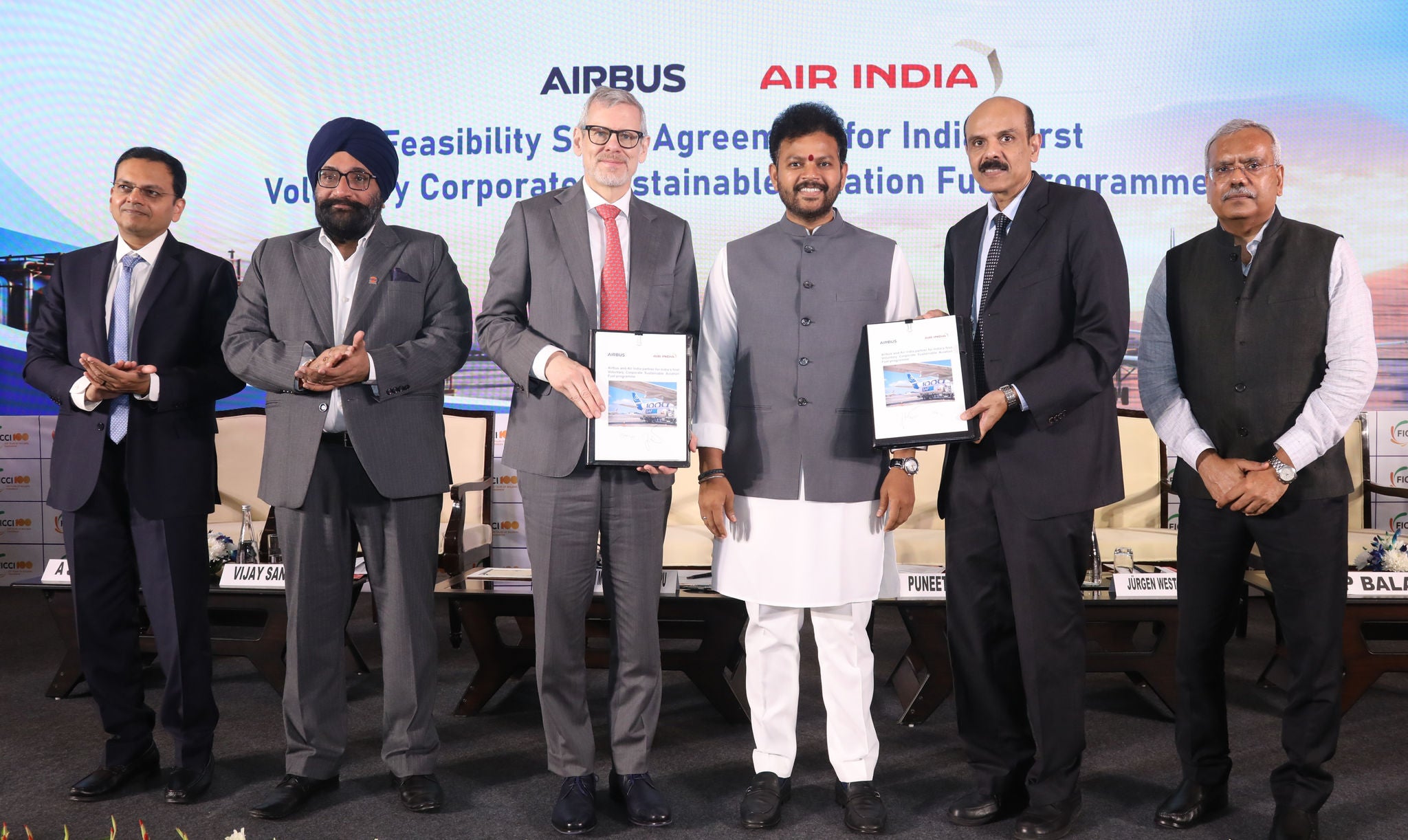
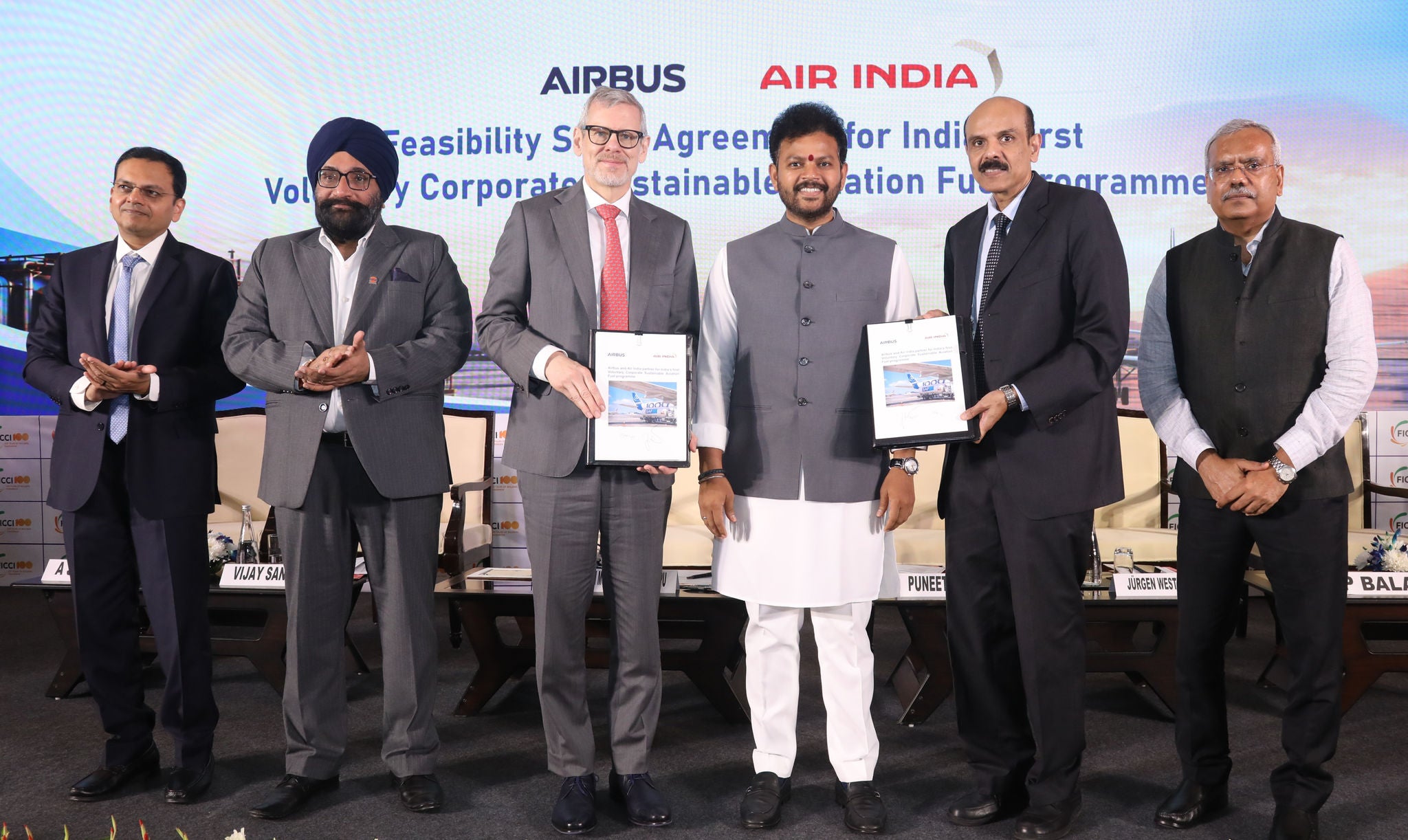
Air India and Airbus have joined hands to develop a framework for India's first Voluntary Corporate Sustainable Aviation Fuel (SAF) programme. The study aims at assessing and setting the framework for a programme open to all businesses seeking to reduce the lifecycle emissions associated with air travel, by enabling voluntary adoption of SAF while helping accelerate decarbonisation.
The Feasibility Study Agreement was signed by Jürgen Westermeier, President and MD, Airbus India & South Asia and P Balaji, Group Head – GRC & Corporate Affairs, Air India in the presence of Shri Rammohan Naidu Kinjarapu, Honourable Minister of Civil Aviation, Government of India.
This study explores a collaboration between Airbus and Air India to develop a SAF corporate offering through the voluntary procurement and use of SAF on selected routes. The initiative would enable Air India to sell or transfer the associated Scope 3 SAF certificates (SAFc) to eligible customers. Upon implementation, it would become India’s first voluntary corporate SAF programme.
Tewolde Gebremariam, CEO & MD, Air India, said: “Achieving aviation's decarbonisation goals will require collective action across the ecosystem. Through this collaboration with Airbus, we are exploring a credible mechanism that enables corporates to support SAF adoption and reduce the emissions associated with business travel. Expanding demand for SAF is essential to scaling production and building a sustainable aviation ecosystem in India, and we are pleased to help lead that effort.”
“Sustainable Aviation Fuel holds the most realistic potential to decarbonise aviation. Airbus is privileged to act as a catalyst to galvanise the SAF ecosystem by collaborating with regulators, airlines, airports, fuel producers and research bodies globally,” said Jürgen Westermeier, President and MD, Airbus India & South Asia. “The collaboration with Air India is a crucial stepping stone to accelerate SAF adoption in the region. Decarbonising aviation demands collective, industry-wide action, and we welcome other corporates to join the programme.”
“Building a viable SAF ecosystem requires demand, collaboration and industry participation. Through this initiative, we aim to create a framework that enables corporates to play a meaningful role in accelerating SAF adoption in India,” P Balaji, Group Head – GRC & Corporate Affairs, Air India.
Under the proposed framework being evaluated, emissions reductions would be determined by comparing the lifecycle carbon footprint of SAF against conventional jet fuel using globally recognised standard frameworks. These verified savings allow participating organisations to credibly track and report progress toward the ‘net-zero carbon emissions’ by 2050 ambition set by ATAG, IATA and ICAO.
The Airbus-Air India feasibility study seeks to build a scalable framework to encourage wider participation across industry sectors and build a robust local SAF ecosystem in India.
The exploratory initiative forms part of Air India and Airbus’ broader multi-faceted strategy to minimise aviation's environmental footprint, combining fleet modernisation, fuel-efficient future generation aircraft design, operational enhancements, SAF adoption and market-based measures to support the industry's commitment to ‘net-zero’ carbon emissions by 2050.
Air India’s fleet renewal plan, with 600 new aircraft on order, including 350 from Airbus, will enable the airline to operate one of the lowest carbon emitting fleets in the world and its plans to establish more non-stop city-pairs will result in less emissive flights and itineraries.
Over the last few years, Air India has adopted market-leading flight planning and optimisation systems, including upgrading its route planning software and coordination with air traffic management.
Air India has also implemented several green practices, including reducing single-use plastics and using lighter material for cutlery and dishes, and is optimising processes such as more frequent engine and airframe washes, implementing single-engine taxiing and autonomous-EV towing to save jet fuel.
*Sustainable aviation fuels refer to renewable or waste-derived aviation fuels that meet sustainability criteria such as those in ICAO's CORSIA or EU's Renewable Energy Directive and that are certified under a recognised sustainability certification scheme (covering the full chain of custody).
